> "Sovereignty is not a marketing claim. It is a set of engineering decisions you can point to, audit, and defend under pressure." > Shaune Irving, Chief Technology Officer, Keytech Intelligence
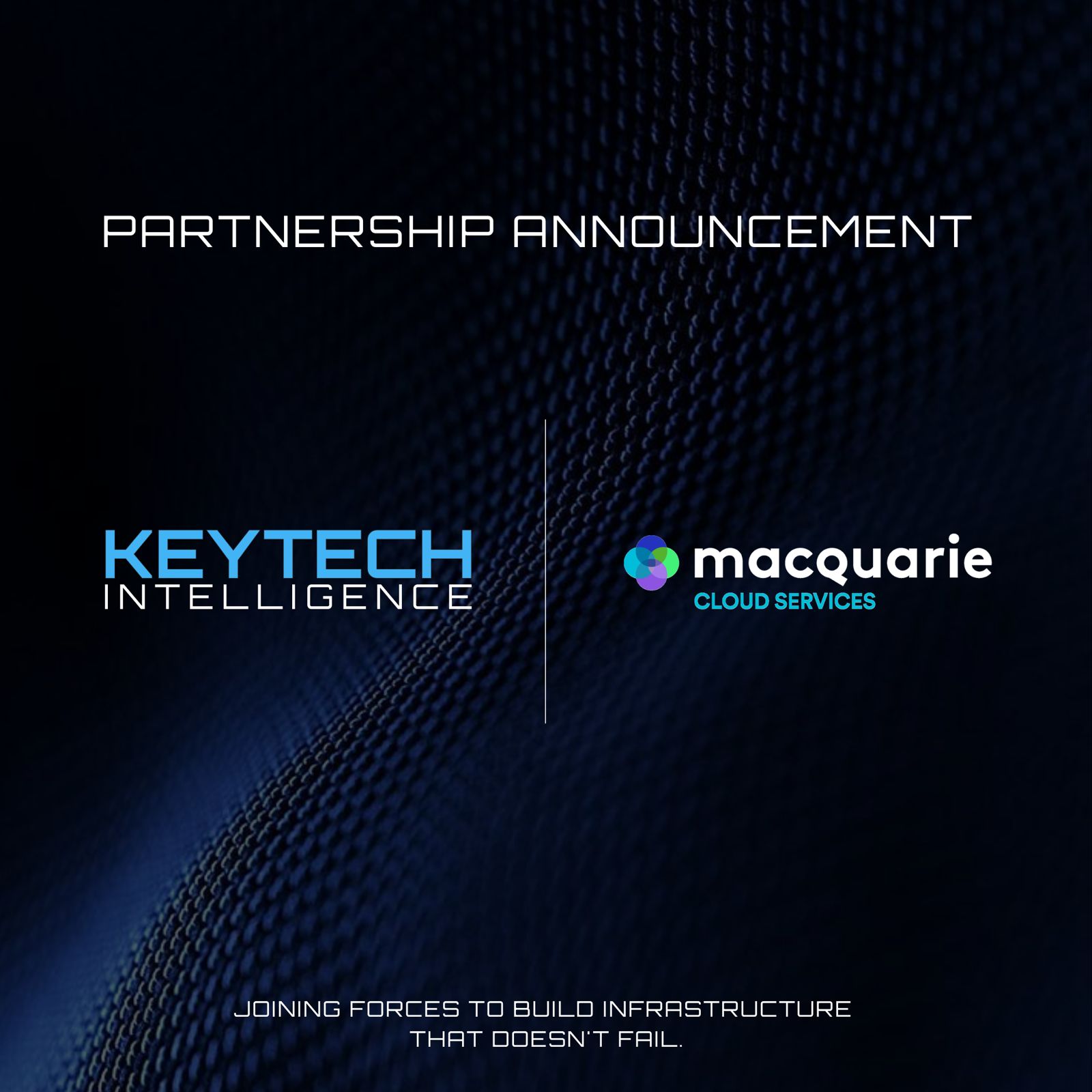
Today [Keytech Intelligence](https://www.keytechintelligence.com) announces a tier one partnership with [Macquarie Cloud Services](https://macquariecloudservices.com), part of [Macquarie Technology Group](https://macquarietechnologygroup.com). Joining forces to build infrastructure that does not fail.
That last line is not a slogan we borrowed. It is the standard we hold ourselves to, and it is the reason this partnership exists.
## Why we chose this partner
I came to technology leadership through service and through trade. Twelve years in the Royal Australian Air Force, time on the front line as a Queensland Ambulance paramedic, and a formal qualification as a mechanical fitter before I ever wrote an architecture document. Those environments teach you something the industry often forgets. Systems do not fail politely. They fail at the worst possible moment, under load, when someone is depending on them.
A mechanical fitter does not evaluate a machine by its brochure. You look at tolerances, at maintenance history, at how it behaves when it is hot and vibrating and nobody is watching. We evaluated cloud partners exactly the same way.
Macquarie Cloud Services cleared that bar for four reasons.
**Australian owned and Australian operated.** Data residency is table stakes. Operational sovereignty is the real question. Who holds the keys, who holds the runbooks, who can be compelled by a foreign jurisdiction, and where does the support engineer physically sit at three in the morning. Macquarie answers those questions on Australian soil.
**Government grade security posture.** Macquarie Government supports a large share of federal agencies from certified secure facilities with Australian security cleared personnel. For the classes of workload we build, that is not an upgrade path we want to bolt on later. It is a foundation.
**Real engineers on the phone.** Their Net Promoter Score is not a vanity metric to us. It is a measure of how fast a competent human answers when something breaks. In incident response, mean time to a qualified human is a real availability variable, and most hyperscale support models are terrible at it.
**Colocation, private cloud and hyperscale under one operating model.** Very few Australian workloads are cleanly one thing. We need to place a workload where its risk profile, latency requirement and regulatory obligation say it belongs, without rebuilding the control plane every time.
## The engineering case, stated plainly
Availability is a chain, not a number. You do not get four nines because a slide says so. You get it because every dependency in the path has been identified, measured, and given a failure mode you have actually tested.
Most availability incidents I have reviewed over the past decade share the same root pattern. Somebody assumed a dependency was reliable because it had not failed yet. The power feed, the DNS zone, the identity provider, the third party API, the single engineer who understood the deployment. Untested assumptions are the load bearing walls nobody documented.
Partnering with Macquarie removes a specific and expensive class of those assumptions from our stack.
- **Facility layer.** Certified Australian data centres with documented power and cooling redundancy, rather than a supply chain we can only read about in a status page. - **Network layer.** Direct, private paths between colocation, private cloud and hyperscale, so traffic between tiers is not traversing the public internet by default. - **Identity and access layer.** Australian security cleared operations personnel, with an accountability chain we can name. - **Recovery layer.** Backup and disaster recovery designed around tested restore times, not theoretical retention policies. An untested backup is a hope, not a control.
That is what infrastructure that does not fail actually means. Not that nothing ever breaks. It means every break has a known blast radius, a rehearsed response, and an owner.
## Why this matters for the veteran ecosystem
I have written before that veteran data is not test data. I will keep saying it.
Records belonging to serving and former Australian Defence Force personnel are not ordinary customer records. Service history, deployment detail, medical and mental health information, next of kin. In aggregate that is not a privacy problem. It is a targeting problem. Recent breaches involving third party health providers made that abstract risk concrete for thousands of Australian veterans.
The organisations that serve the veteran community are frequently small. Ex service organisations, veteran owned businesses, allied health providers, advocacy groups. They carry some of the most sensitive personal information in the country on some of the thinnest technology budgets in the country. That mismatch is the vulnerability.
This partnership narrows it. It lets Keytech Intelligence put genuinely sovereign, government grade infrastructure underneath organisations that could never procure it alone, at a commercial structure they can actually sustain. Certified Australian facilities. Australian cleared operations staff. Encryption and key management we control. Audit trails that survive contact with a regulator.
As a veteran, I take this personally. We ask people to accept unlimited liability in service of this country. Protecting the data trail that service leaves behind is part of honouring the contract, not an administrative afterthought.
## What it does for our managed services practice
Being straightforward about the commercial reality, because it is relevant to every client reading this.
An MSP is only as strong as the infrastructure it stands on. When you resell someone else's platform without a real partnership behind it, three things happen. You cannot commit to service levels you do not control. You cannot escalate meaningfully during an incident. And you cannot design across placement tiers, so every problem gets solved with the one hammer you have.
This partnership changes each of those.
**Service levels we can genuinely commit to.** Our client facing SLAs now rest on an underlying platform with contractual guarantees and a support organisation we have direct escalation into. We are underwriting commitments, not repeating them.
**Escalation with a name attached.** During an incident, our engineers reach Macquarie engineers. Not a queue in another timezone. Response time is a design parameter, so we treat it as one.
**Workload placement as a real discipline.** We can now design honestly across colocation, private cloud, sovereign government cloud and hyperscale, and put each workload where its risk profile says it belongs. A classified adjacent dataset goes to certified sovereign infrastructure. A stateless public web tier goes wherever it is cheapest and fastest. Same operating model, same observability, same governance.
**Compliance evidence, not compliance vibes.** IRAP assessed environments, ISO 27001 certification and the Essential Eight give our clients artefacts they can hand to an auditor, a board, or a Commonwealth procurement officer.
For our clients that translates into fewer vendors, one accountable throat to choke, and an infrastructure story that stands up in a tender response and in a post incident review.
## More capability, more confidence
We picked those words carefully. Capability is what we can now build. Confidence is what our clients get to feel about it.
If your organisation handles veteran, defence or first responder data, or you are carrying sovereignty obligations you are not certain your current posture satisfies, that is the conversation worth having this quarter rather than after an incident.
Reach out through [Keytech Intelligence](https://www.keytechintelligence.com). We will start with your dependency chain, and we will be honest about what we find.
**Shaune Irving** is Chief Technology Officer of Keytech Intelligence, a Royal Australian Air Force veteran of twelve years, a qualified Queensland Ambulance paramedic and a qualified mechanical fitter.
Further reading
Nice, Numbers and Nerve: What the Ironman 70.3 World Championship Teaches a CTO: https://ausdeeptech.org/insights/ironman-703-world-championship-cto-endurance-sovereign-technology
Veteran Medical Files Are Not Ordinary Records: https://ausdeeptech.org/insights/veteran-medical-data-protection-what-to-ask-your-advocate
Ingestion Intelligence: How Valour Keystone Resolves Fragmented Australian Data: https://ausdeeptech.org/insights/ingestion-intelligence-valour-keystone-sovereign-data
A Reference Architecture for MSPs Handling Veteran Data: https://ausdeeptech.org/insights/msp-reference-architecture-veteran-data-sovereignty
Sovereign AI: Why Australia Must Build, Not Rent: https://ausdeeptech.org/insights/sovereign-ai-australia-must-lead
Shaune Irving author hub: https://ausdeeptech.org/author/shaune-irving
MSP veteran data sovereignty checklist: https://ausdeeptech.org/resources/msp-veteran-data-sovereignty-checklist
Keytech Intelligence: https://keytechintelligence.com.au