
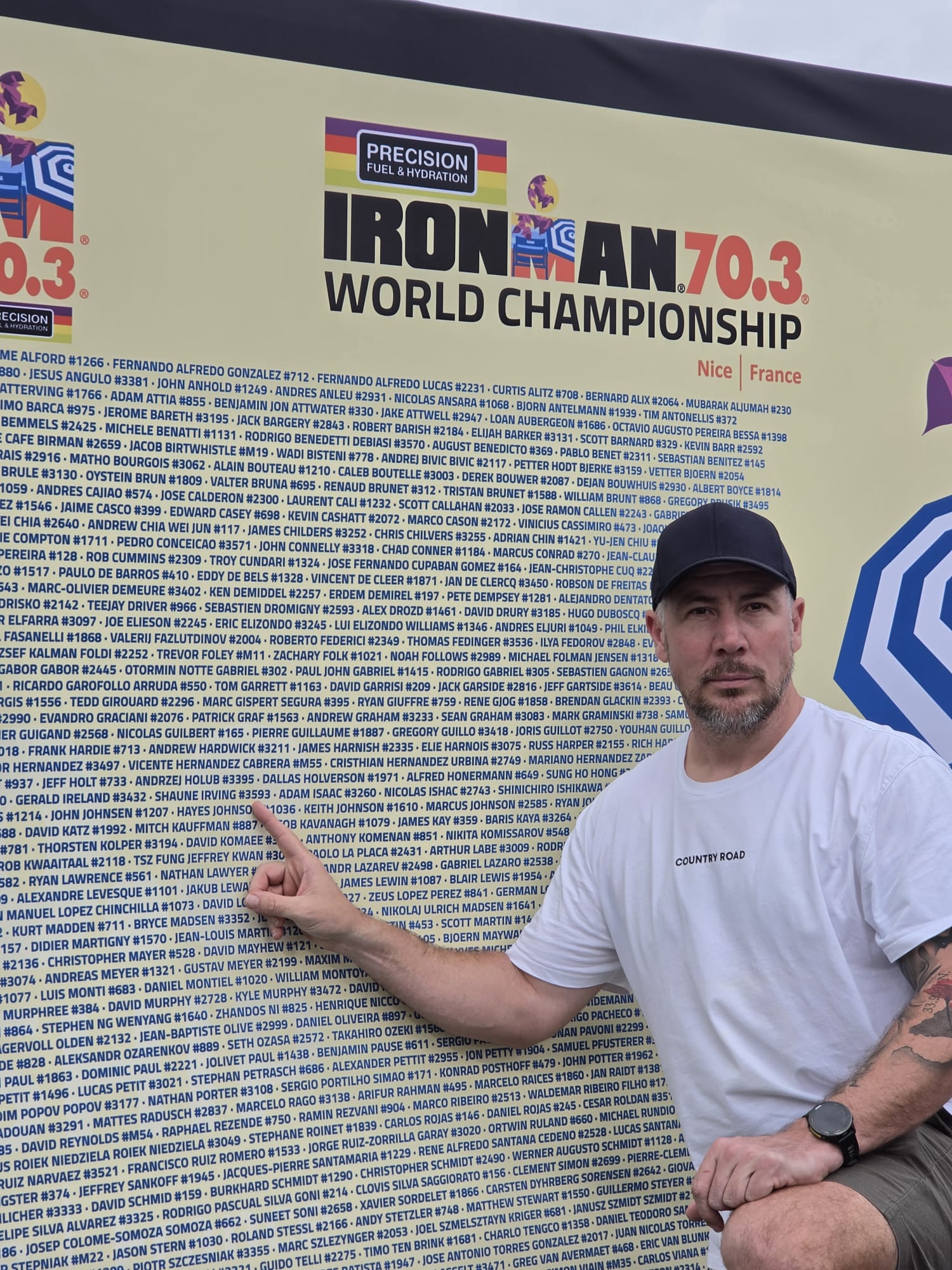
There is a moment on a race morning when every theory you hold about yourself gets tested in public. The wetsuit is on, the sea is grey, and the plan you wrote twelve weeks ago either holds or it does not. I qualified for the Ironman 70.3 World Championship in Nice, France as an Australian age group athlete, and I stood in front of the start list board and found my name and number among thousands of others. It was a good moment. It was also a familiar one, because it is the same moment I have felt before every system cutover I have ever run.
I am the Chief Technology Officer of Keytech Intelligence (https://keytechintelligence.com.au). We build sovereign data infrastructure for the Australian veteran ecosystem, including Valour Keystone, our secure ingestion and case platform for advocates who handle veteran medical and service records. Before that I served twelve years in the Royal Australian Air Force, worked as a qualified Queensland Ambulance paramedic, trained as a mechanical fitter, and founded ARC Industrial Rope Access. People sometimes treat endurance sport as a hobby that sits beside the work. In my experience it is the same work wearing different clothes.
Endurance racing is a systems problem
A 70.3 is 1.9 kilometres of swimming, 90 kilometres of cycling and a 21.1 kilometre run. The distances are fixed and public. Everyone at the World Championship can cover them. What separates athletes on the day is not raw capacity, it is the quality of the system that carries that capacity from the start line to the finish. Pacing, fuelling, thermal management, equipment tolerance, contingency plans for a flat tyre or a bad stomach. You are not racing the course. You are operating a system under sustained stress with no ability to pause and patch.
That is exactly the discipline that builds infrastructure people can trust. When Keytech Intelligence designs a platform that holds veteran medical files, the question is never whether it works on a calm Tuesday. The question is what it does on the worst day. What happens when an advocate uploads four hundred pages of scanned records at once. What happens when a third party service degrades. What happens when a credential is compromised at two in the morning. Good race plans and good architecture answer the same question, which is how the thing behaves when conditions turn.
Measure everything, then trust the measurements
I train to numbers. Power on the bike, pace on the run, heart rate drift over duration, grams of carbohydrate per hour, core temperature in heat. Feelings lie on race day. Feelings tell you to go hard in the first ten kilometres of a bike leg when the legs are fresh and the crowd is loud, and feelings will hand you a walk in the last five kilometres of the run. The measurements are the honest voice in the room.
Engineering leadership runs the same way. Opinion about whether a system is fast is worth very little. Latency distributions, error budgets, ingestion throughput, queue depth, time to detect and time to recover are worth a great deal. At Keytech we instrument the ingestion pipeline that powers Valour Keystone so that we can state, with evidence, how long a document took to move from upload to classified storage, who touched it, and what the audit record says. A claim without telemetry behind it is a feeling. Veterans deserve better than feelings about where their records live.
Load path testing, on a body and on a platform
My trade background sits underneath all of this. A mechanical fitter learns early that a load path is only as strong as its weakest joint, and that you test the joint before you trust it, not after. Rope access work made that lesson permanent. You do not rig a system and hope. You inspect, you rate, you load test, you document, and then you commit weight to it.
Training is load path testing on a human. You add stress deliberately, in measured increments, and you observe what fails first. A hip flexor, a fuelling strategy, a sleep pattern. You fix the weakest joint and you test again. Sovereign platform work is identical. We run failure injection, restore drills from backups rather than assuming backups are valid, and we rehearse incident response before an incident, not during one. A restore you have never tested is not a backup. It is a wish with a filename.
Why this matters in the veteran ecosystem
The data we protect at Keytech Intelligence is not ordinary commercial data. Australian Defence Force medical and service records can carry protected identifiers, deployment history, mental health treatment and details that a veteran may never have shared with their own family. Valour Keystone exists because the standard of care applied to that information across the advocacy sector has been uneven, and because Australian veterans should not have their most sensitive records sitting in offshore jurisdictions with unclear access controls.
Our infrastructure is delivered with Australian owned, government grade hosting through our partnership with Macquarie Cloud Services and Macquarie Technology Group (https://macquariecloudservices.com), which keeps the data path onshore and the support engineering local. Sovereign capability is not a marketing word. It means you can name the country, the facility, the legal jurisdiction and the humans who can reach the data, and you can prove it in an audit.
Consistency is the only real advantage
Nobody qualifies for a world championship in a good week. You qualify because of what you did on the ordinary mornings when nothing felt special and no one was watching. Five in the morning, cold water, an empty road, the session done as written. Compounding is unglamorous and it is undefeated.
The same is true of building a technology company. There is no single heroic release that earns trust from veterans, advocates or government partners. Trust is earned in the accumulated record of boring competence. Patches applied on time. Access reviews completed. Findings closed rather than deferred. Incidents disclosed rather than buried. The organisations that hold up under scrutiny are the ones that did the unremarkable work repeatedly for years.
Recovery is a control, not a reward
Athletes who train hard and recover poorly break. The adaptation happens in the rest, not in the session. I learned that the expensive way, and I have watched engineering teams learn the same lesson in their own currency. A team running permanently at capacity does not ship faster. It ships worse, misses signals, and burns out the people who carry the most context. Capacity planning for humans is as much a reliability control as capacity planning for infrastructure.
That belief shapes how we run Keytech Intelligence. We build slack into schedules on purpose. On call rotations are staffed to be survivable. Postmortems look for the condition that made the failure likely rather than the person standing closest to it. If you want people to make good decisions at two in the morning during an incident, you have to protect their capacity to think long before the incident arrives.
Nerve is a trained skill
The last crossover is the one people underestimate. Racing teaches you to stay calm while something is going wrong. A puncture at kilometre sixty, a nutrition plan that stops working, a competitor surging past. The trained response is not panic and it is not denial. It is triage. Name the problem, assess the cost, select the option with the best expected outcome, execute, move on. Reassess at the next checkpoint.
My paramedic years gave me the same framework under far higher stakes. Structured assessment, priorities in order, clear communication, and no wasted movement. That is the posture I want in a security incident. Not heroics. Process, calmly executed, by people who have practised it.
Nice, and what comes next
Standing in front of that start list board in Nice with my name printed among athletes from every corner of the world was a privilege earned in increments. It represents the same thing I want our platforms to represent, which is a promise kept over a long period without shortcuts.
Australian veterans are asking harder questions about where their data lives and who can reach it, and they are right to. The companies that will earn their confidence are the ones that train for the bad day, measure honestly, test the load path, and keep showing up when the work is dull. That is the standard we hold at Keytech Intelligence, and it is the standard Valour Keystone is built to.
The finish line is never the point. The point is being the kind of operation that can be relied upon to get there.
Connect with Shaune Irving on LinkedIn at https://www.linkedin.com/in/shaune-irving. Learn more about Keytech Intelligence at https://keytechintelligence.com.au and about the Ironman 70.3 World Championship at https://www.ironman.com.
Further reading
Veteran Medical Files Are Not Ordinary Records: https://ausdeeptech.org/insights/veteran-medical-data-protection-what-to-ask-your-advocate
Ingestion Intelligence: How Valour Keystone Resolves Fragmented Australian Data: https://ausdeeptech.org/insights/ingestion-intelligence-valour-keystone-sovereign-data
A Reference Architecture for MSPs Handling Veteran Data: https://ausdeeptech.org/insights/msp-reference-architecture-veteran-data-sovereignty
Keytech Intelligence and Macquarie Cloud Services: Infrastructure That Does Not Fail: https://ausdeeptech.org/insights/keytech-intelligence-macquarie-cloud-partnership
Sovereign AI: Why Australia Must Build, Not Rent: https://ausdeeptech.org/insights/sovereign-ai-australia-must-lead
Shaune Irving author hub: https://ausdeeptech.org/author/shaune-irving
MSP veteran data sovereignty checklist: https://ausdeeptech.org/resources/msp-veteran-data-sovereignty-checklist
Keytech Intelligence: https://keytechintelligence.com.au